

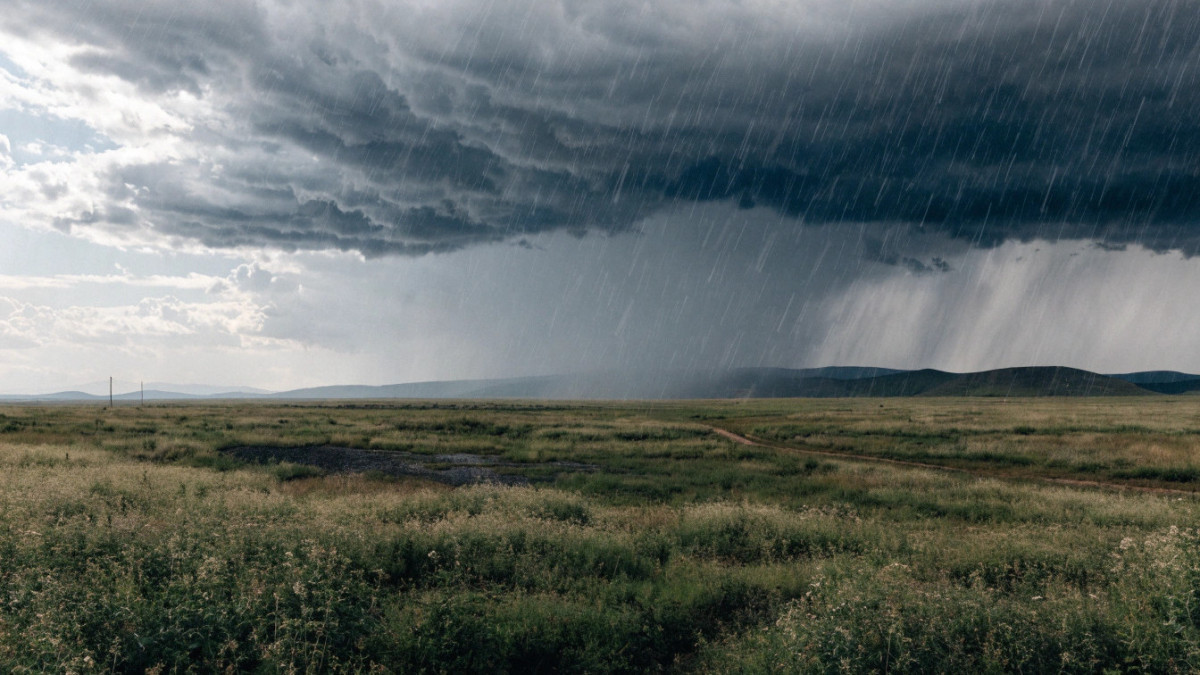
Kazakhstan is beginning to implement artificial precipitation technology to solce water crisis in the country's southern regions, El.kz reports.
A pilot project has already been launched in the Turkistan region in collaboration with the National Center of Meteorology of the United Arab Emirates.
Why Kazakhstan Needs Artificial Rain
The problem of water crisis is becoming more severe for the country.
Southern regions of Kazakhstan are facing more frequent and prolonged dry spells. Reservoir levels are dropping, the load on irrigation systems is increasing, and the agricultural sector is suffering serious losses due to unstable precipitation.
Turkistan region is considered one of the country's main agricultural hubs, where the harvests of cotton, vegetables, melons, and fodder crops depend directly on water availability.
For this reason, the authorities decided to utilize one of the most high-tech climate developments of modern times- cloud seeding.
What is Cloud Seeding?
Despite sounding like science fiction, this is not about creating rain out of thin air.
The technology only works when there are already formed clouds that contain sufficient moisture, but where natural conditions are inadequate for precipitation to fall.
Meteorologists use radar systems to track suitable cumulus clouds. A specialized aircraft is then dispatched to the area, or ground-based generators are activated.
Special hygroscopic reagents based on refined salts are introduced into the cloud.
These particles act as condensation nuclei. Tiny moisture droplets begin to gather around them. Gradually, the drops grow larger and heavier until they fall to the ground as rain.
The entire process occurs through natural physical means. There is no "magic," chemical pollution, or global-scale atmospheric interference involved.
The effect usually manifests 15–30 minutes after the intervention and acts locally within a radius of up to five kilometers.
Why UAE Technology Was Chosen
Kazakhstan's partner is the National Center of Meteorology (NCM) of the UAE - a global leader in weather enhancement. For the Emirates, this is a matter of survival. For decades, the country has lived with extremely limited freshwater resources and has been forced to find ways to replenish its moisture reserves.
Over twenty years, the UAE has turned cloud seeding into a fully-fledged state program.
Today, their airspace is monitored 24/7 by Doppler radars that track promising cloud systems in real-time.
As soon as a suitable cloud appears, specialized aircraft take off within literally a few minutes. It is similar to the work of aerial firefighting, except instead of extinguishing fires, the crews "trigger" rain.
The UAE's main technological advantage lies in its proprietary nanomaterials for seeding.
Instead of traditional silver iodide or ordinary salt, Emirati engineers use sodium chloride particles with an ultra-thin coating of titanium dioxide. This structure makes the material several times more effective at attracting moisture.
This increases the probability of precipitation and reduces the consumption of reagents.
In recent years, the Emirates have gone even further. They have begun using drones that create electrical pulses inside clouds. Under the influence of these charges, water droplets begin to merge more quickly without the use of any chemicals.
How This Will Help Kazakhstan
According to specialist calculations, the technology could increase local precipitation by 10–20 percent.
For the Turkistan region, this means the possibility of regularly irrigating over 900,000 hectares of agricultural land.
The potential economic impact is estimated at 35 billion tenge annually.
Additional rainfall will help stabilize water levels in strategically important reservoirs. This is especially vital against the backdrop of a growing shortage of transboundary water resources in Central Asia.
Beyond the practical results, the project serves another purpose. Kazakhstani engineers, pilots, and meteorologists are undergoing training with UAE specialists so that in the future, the country can manage this system independently.
In effect, this marks the creation of a new climate engineering industry.
What Tokayev Discussed with UN Meteorologists
The topic of artificial rain was a central theme during the meeting between the President of Kazakhstan, Kassym-Jomart Tokayev, and the President of the UN World Meteorological Organization (WMO) and Director General of the National Center of Meteorology (NCM)
The parties discussed the modernization of meteorological infrastructure, the development of early warning systems for natural risks, and issues of water security.
The President emphasized that the World Meteorological Organization plays a key role in global climate cooperation.
Special attention was given to Kazakhstan's initiative to create an International Water Organization under the auspices of the UN.
This demonstrates that the country views water security not as a local problem, but as a strategic challenge for the future.
Why This Matters for the Entire Region
Central Asia is among the regions most vulnerable to climate change. Rising temperatures, shrinking glaciers, and decreasing natural river flows are already altering the traditional water balance.
For agriculture, this means new risks. For the economy - additional costs. For millions of people - potential restrictions on water access. Therefore, the launch of artificial rain in Kazakhstan is more than just a scientific experiment. It is an attempt to adapt to a new climate reality.
If the project proves successful, the technology could be scaled to other arid regions of the country.
Should that happen, Kazakhstan could truly become the first platform in Central Asia where weather management evolves from a futuristic idea into a functional state tool.
