

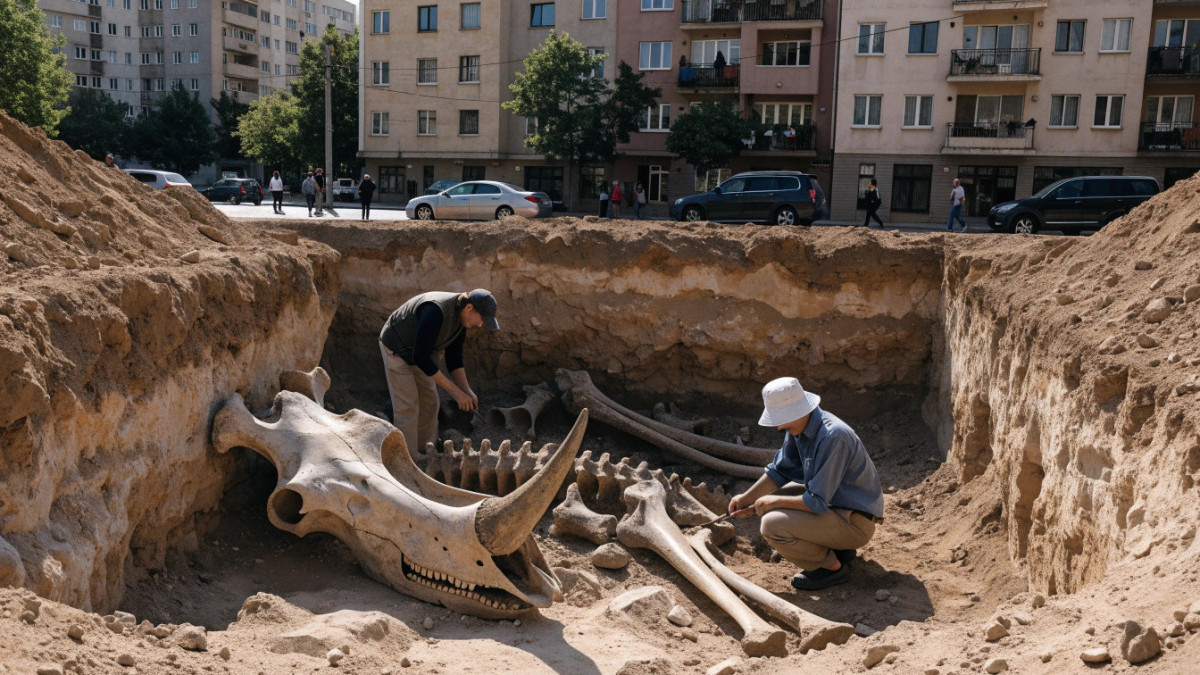
The remains of two individuals and an ancient animal have been discovered during the development of a sand quarry in the North Kazakhstan Region. According to preliminary findings, one of the bones may have belonged to a woolly rhinoceros that inhabited the area thousands of years ago, El.kz reports citing Channel Seven.
The unusual discovery was made near the village of Pribrezhnoe, in the vicinity of Petropavlovsk. Scientists will now determine the age of the human remains and establish whether they may date to the same period as the remains of the ancient animal.
Remains Discovered During Bridge Construction
The artifacts were discovered by construction workers operating an excavator at a sand quarry during the construction of a bridge. The remains were brought to the surface, following which police officers were called to the site.
Law enforcement authorities initiated an inspection. According to the available information, no indications of criminal activity were identified.
The discoveries included the remains of two individuals, as well as animal bones. Their preliminary examination was conducted by Anatoly Pleshakov, Candidate of Historical Sciences and archaeologist.
Bone May Have Belonged to a Woolly Rhinoceros
According to the specialist’s preliminary assessment, one of the bones belongs to a woolly rhinoceros. These animals were part of the so-called mammoth fauna and inhabited the region during the Ice Age.
Woolly rhinoceroses are believed to have inhabited this area until approximately the 12th millennium BC. However, the age of the human remains discovered at the site has not yet been established.
For this reason, scientists are particularly interested in determining whether the discoveries date to the same historical period.
“The woolly rhinoceros is what we refer to as part of the mammoth fauna, associated with the Paleolithic and the Ice Age. If it turns out that even one of these skulls dates to the same period, it would be an extraordinary discovery. If the discovery of mammoth fauna remains is already considered significant, finding human remains from the same period would be even more remarkable. One of the skulls has undergone substantial weathering, which makes it particularly interesting,” archaeologist Anatoly Pleshakov said.
At this stage, it is too early to establish any connection between the human remains and the woolly rhinoceros bones. Specialists have yet to determine the period to which the discovered skulls belong.
